
Can green LiDAR see through my water?
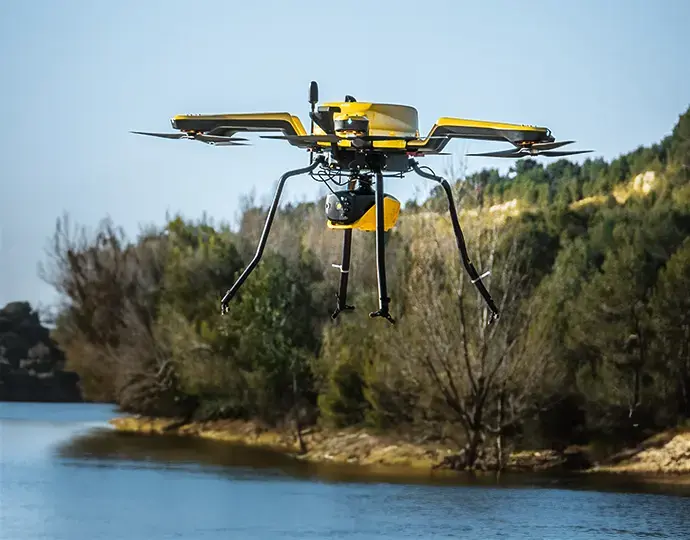
If you can see the bottom, there's a good chance. Green LiDAR measures depth with light, so how far it sees depends on how clear the water is. For the YellowScan Navigator, the rule of thumb is about two Secchi depths.
What is Secchi depth?
A Secchi disc is a flat disc, usually 20 cm across and often black and white in quarters, lowered into the water on a marked rope or tape. The depth at which it disappears from view is the Secchi depth. It is a simple, cheap and widely used measure of water clarity, and it is the number green LiDAR performance is quoted against.
The Navigator's maximum depth is rated at 2 Secchi depths. As a rough guide:
Secchi depth | Approximate measurable depth |
0.5 m | About 1 m |
1 m | About 2 m |
2 m | About 4 m |
3 m | About 6 m |
Illustrative only. Real results depend on the conditions further down this page.
How to measure it on site
Pick a bright, calm day and measure between about 10am and 3pm, when the sun is high.
Take your sunglasses off, and measure from the shady side of a jetty, boat or bank so glare doesn't hide the disc.
Lower the disc slowly until it just disappears. Note the depth.
Raise it until it just reappears. Note that depth too.
Average the two. That's your Secchi depth.
Repeat in two or three spots, and take a photo of the water while you're there.
If the disc is still visible when it reaches the bottom, the water is clearer than it is deep, which is good news for LiDAR. Write down the depth and "visible on bottom".
Why clarity matters so much
The Navigator's 532 nm green laser travels down through the water, reflects off the bottom and travels back up. Anything in the water column scatters or absorbs that light on the way: suspended sediment, algae, and the dissolved organic matter that stains water the colour of tea. The more of it there is, the weaker the return from the bottom, until there is nothing left to measure.
Sound behaves differently. An echosounder works in water you can't see your hand in, which is why tailings ponds and silty dams are echosounder jobs.
What else affects the result
Recent weather. Rain, wind and runoff can turn a clear creek brown for days. Check the days before the survey, not just the day itself.
Season. Algal blooms in the warmer months can cut clarity sharply in dams and lakes.
Bottom type. Sand and rock give strong returns. Silt and dense weed absorb or scatter the light, so the same water can give different depths over different beds.
Water surface. Choppy water scatters the laser, and a glassy, mirror-flat surface can bounce it away from the sensor. A light ripple is often better than dead calm.
Sun. Strong midday sun adds noise that can hide weak bottom returns, so flights often go better early or late in the day. (Measure the disc near midday, fly early or late.)
Depth beyond reach. Where the bed is deeper than the light can reach, you'll see a gap in the point cloud. Plan to fill it another way.
Which Australian water bodies tend to suit it?
Every site is different, so treat this as a starting point, not a promise.
Often a good fit: clear rivers and creeks in a dry spell, sandy coastal shallows and estuaries on a clear day, and quarry or gravel pit lakes.
Test first: water storages, lakes and farm dams. Clarity varies a lot with the season and the catchment.
Usually not: tailings ponds, sediment and stormwater basins, and anything brown after rain. Use an echosounder.
If your water isn't clear enough
You still have options. A drone echosounder or a McBathy survey boat will measure turbid water to its full depth. You can also combine methods: fly LiDAR for the banks and clear shallows, and use an echosounder for the deeper or murkier parts, all tied to the same GNSS control.
What this means for your site
Send us your Secchi reading, a photo of the water, the location and the time of year you plan to survey. We'll give you an honest answer on whether the Navigator suits it. If it looks promising, a day's hire is the best way to prove it on your own water before you buy.
Want to talk about your site?
Send us a few details and we'll recommend the right setup, with a buy and a hire option.

